Beyond Camellia Sinensis:
Why the Western World is Relearning the Word ‘Tisane’
A return to visible leaves, whole-form botanical clarity, and the lost art of the non-caffeinated ritual.
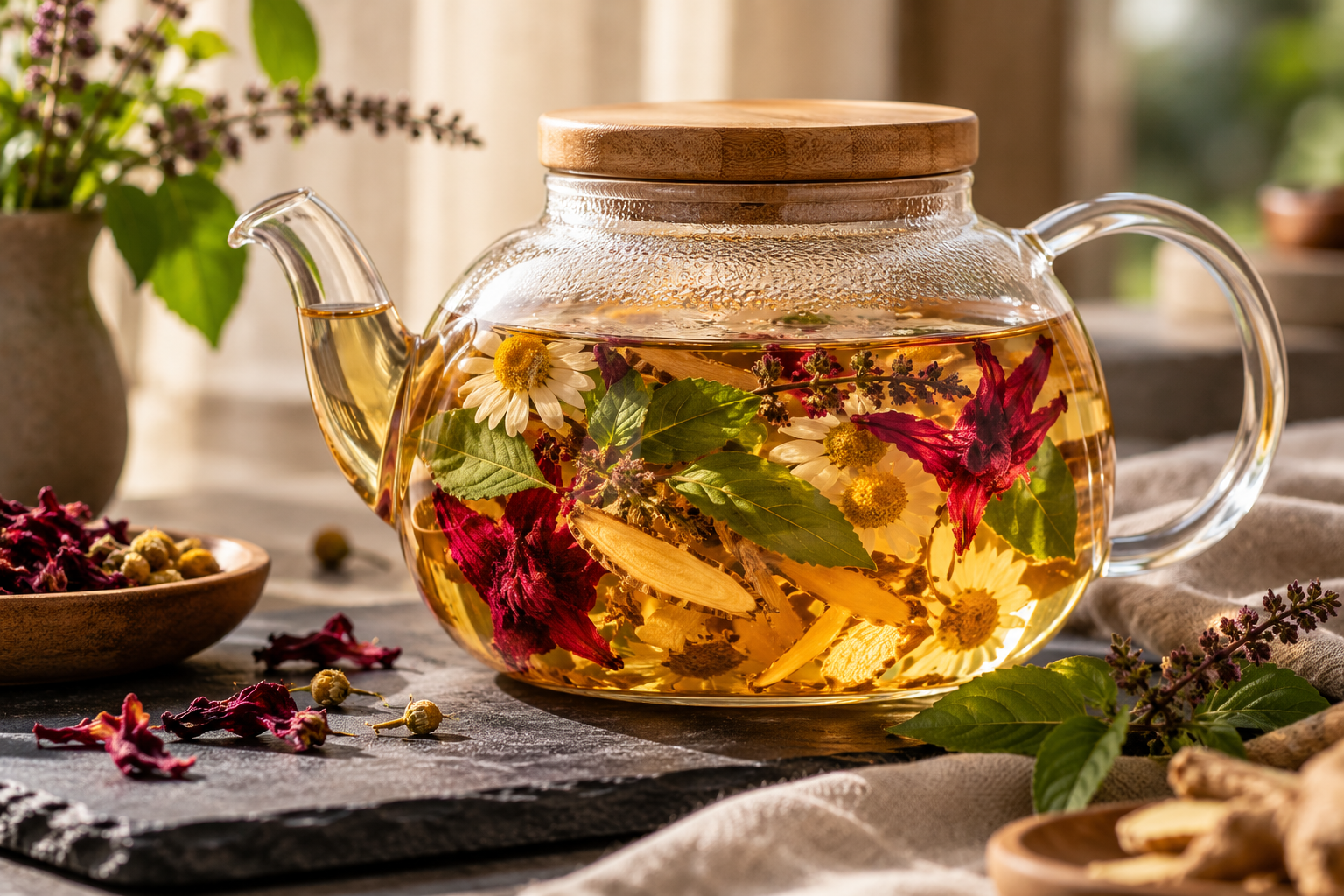
For over three centuries, the Western morning ritual has been held captive by a single botanical species: Camellia sinensis. Whether oxidized into robust British Breakfast blends, steamed into Japanese Sencha, or gently rolled into high-mountain Oolongs, the world collapsed thousands of distinct plant varieties under a single shorthand noun: tea.
Anything outside this single species was relegated to the margins—often labeled casually as “herbal tea,” an accidental linguistic paradox equivalent to calling a peach an “apple with soft skin.”
In 18th-century French apothecary salons, however, a clear distinction was maintained. The word tisane (derived from the Greek ptisanē, denoting a decoction of crushed grains and herbs) described an entirely different art form: the intentional, slow extraction of wild flowers, bark, roots, seeds, and leaves. Tisanes were never formulated as tea substitutes or diluted afternoon compromises; they were sensory elixirs composed for clarity, restoration, and somatic balance.
Today, modern life is driving a quiet renaissance of this classical taxonomy. As consumers push past the friction of jitter-inducing caffeine spikes and synthetic functional dusts, the ritual of the botanical cup is returning to its original elegance.
The Tyranny of the Bleached Paper Sachet
The mid-twentieth century brought convenience at a heavy aesthetic and sensory price: the mass-market tea bag. To fit inside paper envelopes and infuse in under ninety seconds, botanicals were pulverized into “dust and fannings”—the lowest grade in classical tea classification.
In this crushed state, the integrity of the plant suffers threefold:
- Volatile Degradation: Essential aromatic oils vaporize rapidly on warehouse shelves.
- Flattened Profiles: Nuanced terpenes degrade into astringent, muddy tannins.
- Erasure of Form: The plant’s visual architecture and living story disappear completely.
The consumer is left with an opaque liquor steeped from anonymous powder.
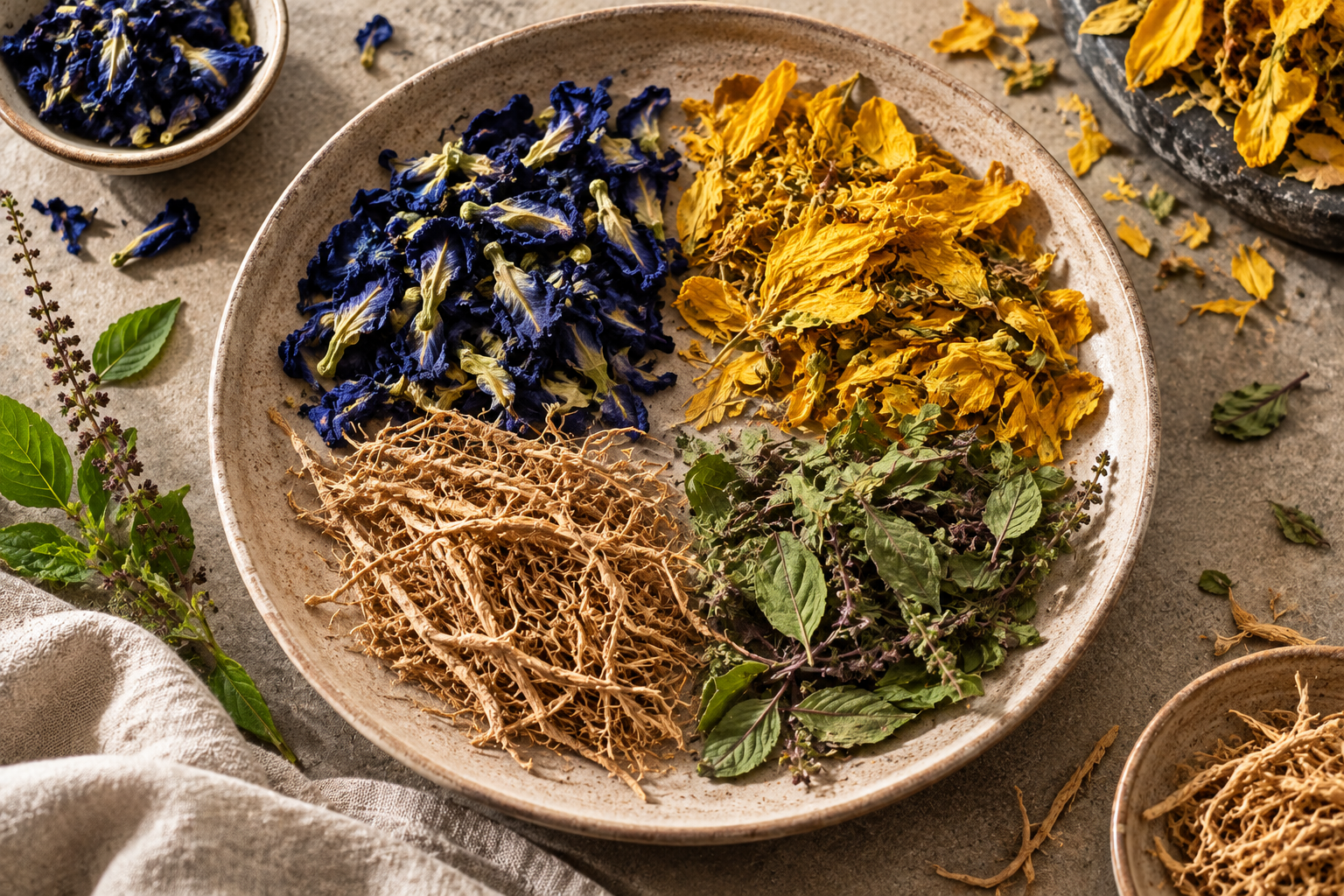
At INDIAN TISANE™, we return to the charter of visible botany. When hot water touches a blend like Pranagama or Deep Flow, there are no synthetic aromatics or bleached paper filters to hide behind. You see the serrated architecture of Rama Tulsi, the cobalt petal structure of sun-cured Butterfly Pea (Aparajita), and the fibrous warmth of crushed galangal and wild Vetiver roots.
“Rather than hiding botanicals behind powders or anonymous blends, we celebrate their natural colour, structure, aroma and character.”
The botanical is not hidden; it unfolds.
Cultivating the Five-Minute Respite
The resurgence of the tisane is not solely an ingredient movement; it is an architectural reclamation of time.
A traditional black tea leaves little margin: steep it twenty seconds past three minutes, and bitter polyphenols overpower the palate. A tisane composed of pure roots, leaves, and whole flowers behaves differently:
- Thermal Resilience: Without the astringent tannins of Camellia sinensis, tisanes steep gently at 90°C to 95°C for five to seven minutes without bitterness.
- Optical Meditation: In a clear borosilicate vessel, the water gradually turns from transparent to luminous ambers, deep forest greens, or royal sapphire blues.
- A Non-Punitive Ritual: It provides an authentic evening or late-afternoon punctuation mark that honors focus without demanding an adrenal toll.
The shift toward the tisane signals a transition from drinking purely for chemical stimulation to drinking for presence—a return to a botanical craft that respects both plant and palate.